
The Life of a Surgeon
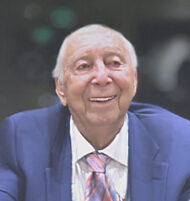
Reza Khatib’s dream of becoming a neurosurgeon during the second World War when a very popular Mashhad public official sustained what would become a fatal head injury. An autopsy confirmed that death had resulted from an epidural hematoma, and an inquisitive Reza quickly learned that a neurosurgeon, if present, could have saved the man’s life. With the encouragements and advantages his parents were able to provide, Reza visualized a successful medical career, and possibilities for living and working in the United States.
He completed his early training at Tehran Medical School in 1956, and came to the United States in 1958. His started with a one year internship at Harlem Hospital (New York City), followed by a one year residency in pathology at Barnet Memorial Hospital (Paterson, New Jersey). This was followed by a one year neurological residency at Jewish Chronic Disease Hospital (Brooklyn, New York).
Reza soon enjoyed a great deal of career success. He and Georgie shared a capacity for empathy that would fuel their enduring dedication to patients and their families.
During the years of his New York practice Dr. Khatib was saddened and increasingly frustrated by the plight of patients and families when the diagnosis was Glioblastoma Multiforme, a prevalent and very often fatal form of brain cancer. He shared his sadness and frustrations with his wife Georgie and his medical colleagues. Addressing the need for a GBM cure would become his lifelong mission, and his primary motivation for creating the Dr. Reza Khatib Foundation.
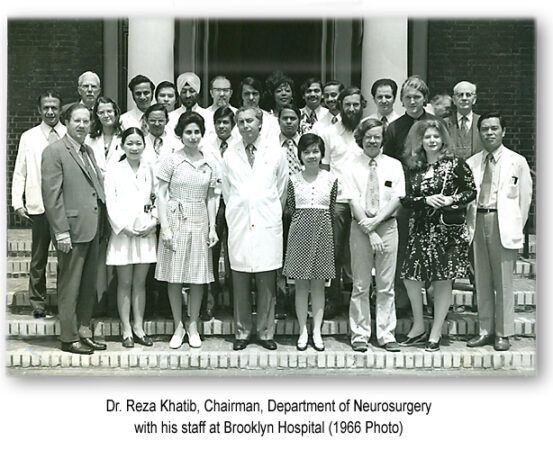
 Reza was very successful at building interpersonal relationships with patients and colleagues, and his willingness to invest in teamwork was a powerful factor in seeking significant breakthroughs in clinical practice, neurology, oncology, the treatment of intracranial aneurysms, and the treatment of spinal cord injuries. And he learned important administrative skills from colleagues that would play an important role in the successes to come.
In the years that followed they initiated wide-reaching philanthropic projects in the United States and abroad, enlisting the support of a network of colleagues and personal friends. Their Khatib Foundation focused support on the fight against glioblastoma in all its forms with projects designed not only for today, but to last well into the future. See the Foundation Page for more on this work.
|
In New York (3:30) |
|
Reza was also introduced to Dr. Jefferson Browder and Dr. Al Cook, who was serving as Chairman of Neurosurgery at Downstate Medical School and Kings County Hospital, where Reza’s full five year neurosurgical residency began. Each year of his residency, Reza’s empathy for glioblastoma patients and their families continued to grow, as did his frustration at having so little to offer them. His dedication to finding glioblastoma’s cure strengthened and his plan for what would become the Dr. Reza Khatib Foundation took root. |
|
Working with Dr. Parza, Reza designed a new research-oriented position that would specifically target work on the gliobastoma problem. The result of their association endures as the Khatib/Parsa Endowed Chair for Treatment of Skull-Based Tumors at the University of California, San Francisco. After serving as the university’s first endowed chair, Dr. Parza moved on to build a wonderful reputation, cut all too short by his untimely death at age 47. He is survived by his wife, Dr. Charlotte Shum, who became associate professor of orthopedic surgery at the Feinberg School of Medicine, Northwestern University. Today, Dr. Shum also serves as one of the distinguished trustees of the Khatib Foundation. |
 The early years:
Reza first met Dr. Abraham Rabiner in Brooklyn, New York. Dr. Rabiner was Chief of Neurology, and meeting him was a great honor. This photo of them was taken at the Jewish Chronic Disease Hospital of Brooklyn in 1959, the year John F. Kennedy was elected President of the United States.
The early years:
Reza first met Dr. Abraham Rabiner in Brooklyn, New York. Dr. Rabiner was Chief of Neurology, and meeting him was a great honor. This photo of them was taken at the Jewish Chronic Disease Hospital of Brooklyn in 1959, the year John F. Kennedy was elected President of the United States. It was also during that first resident year that Reza met Dr. Andy Parsa at Downstate Medical School, then involved in GBM research at Columbia University. Dr. Parsa impressed Reza from the first day they met with his intelligence and the energy he devoted to his research. Reza quickly decided to financially assist Dr. Parsa during his residency and his activities at Columbia University, University of California at San Francisco, and Northwestern University.
 After completing his fifth year of residency, Dr. Khatib became Chief of Neurosurgery at Brooklyn Medical Center. His own highly successful neurological private practice continued. During the years in New York Dr. Khatib’s colleagues and friends included three other neurosurgeons trained at Downstate Medical Center. These personal friends were Doctors John Miller, Richard Johnson and Fred Nobandegani. All were highly valued and respected colleagues.
|
 In his years of practice, Dr. Khatib published to professional to journals numerous times. See his
Credentials
Tehran Medical School
1950-1956 | M.D
University Hospital , Tehran , Iran
1955 – 1956 | Intern
Harlem Hospital , New York
1958 | Rotating Internship
Barnert Memorial Hospital, Patterson, New Jersey
Jan 1959 – Dec 1959 | Pathology Residency
Jewish Chronic Disease Hospital
Jan 1959 – Dec 1960 | Neurology Residency
Kings County Hospital, Brooklyn
Jan 1961 – Jun 1965 | Neurosurgery Residedency
Licenses
Licensed to practice Medicine
State of New York, 1967
License #: 098762-1
Compensation Board, CNS, 1967
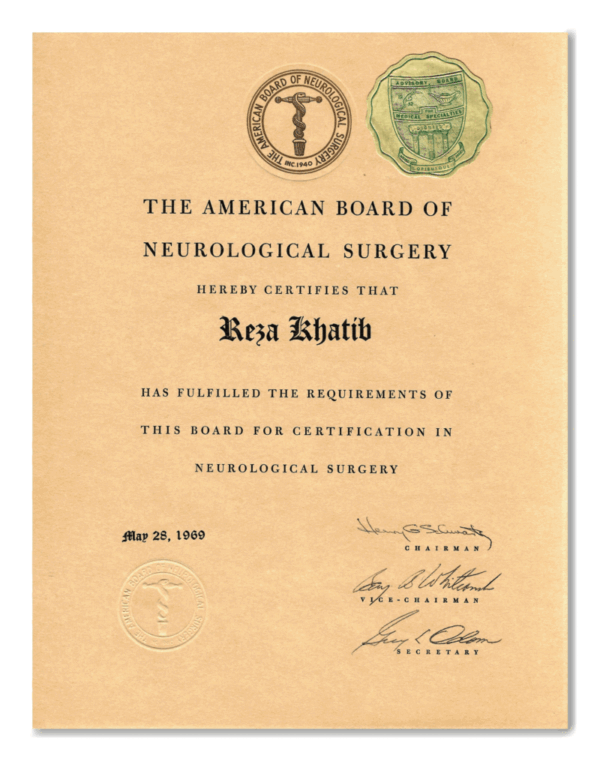
Authorization #: 21415, May 1969
Fellow of American College of Surgeon (FACS)

